

The question is usually posed as if you had to choose sides: either machine or person. And posed this way, it has no good answer, because both options are bad in their pure form — translating five hundred pages by hand doesn't work, and publishing five hundred pages without anyone reading them doesn't work either.
The useful answer is not "which one," it is "where". Automate volume, pay human review where money is decided.
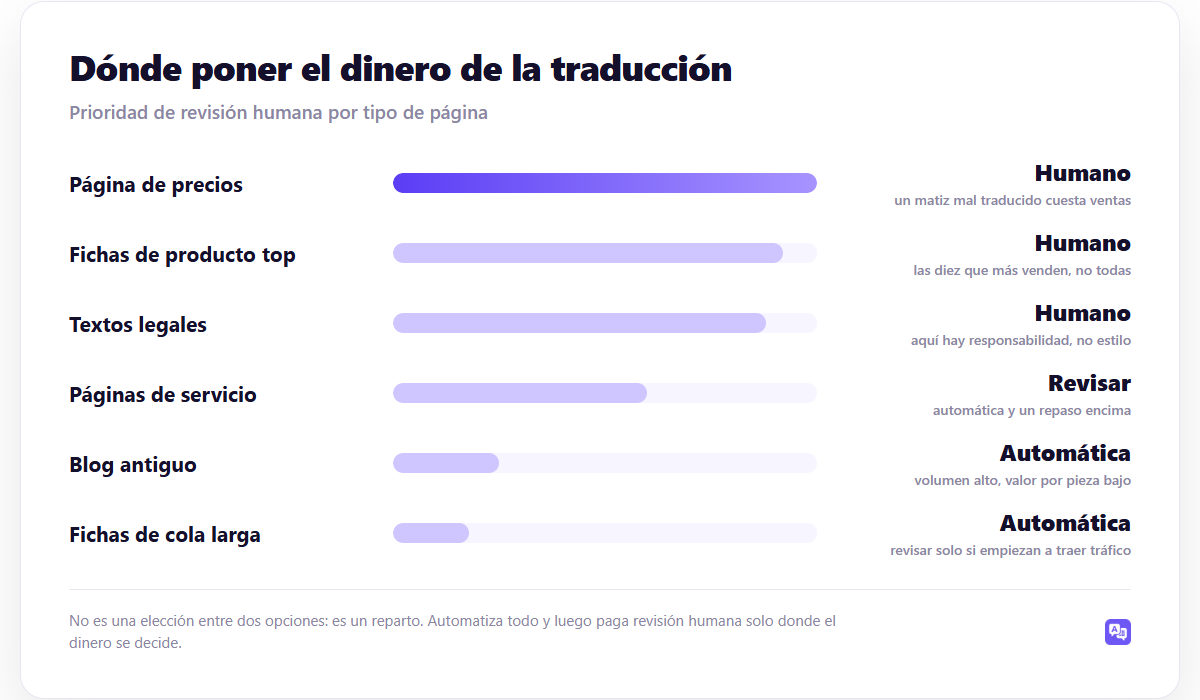
To the point: It is not a choice between two options: it is a distribution. In a typical project, between 5 and 10% of the pages account for almost all the conversions. Those are checked by hand. The rest is automatically translated and reviewed only if it starts bringing traffic. That rule resolves the question in practice.
Where is everyone today?
It is advisable to update expectations, because the debate brings up ideas from ten years ago.
Automatic translation among majority European languages is, today, good. Not perfect: correct. It understands the context of the sentence, respects the register reasonably well and does not produce the gibberish it produced before. It fails in the same things as always: the brand tone, the word games, the terminology of a sector and the nuances that change a purchasing decision.
The professional translator It remains irreplaceable exactly there: in what it persuades, in what it legally requires and in what defines how your brand sounds. What has changed is that it no longer makes sense to pay you to translate a blog article from 2019 that receives four visits a month.
The real cost, with numbers
| Automatic | Automatic + review | Professional | |
|---|---|---|---|
| Indicative cost | Cents per page | Low, depending on what you review | €0.08-0.15 per word |
| A 200 page website | one afternoon | Days | Weeks or months |
| Quality | Correct | Buena | Alta |
| brand tone | No | Yes, where you check | Yes |
| Scale | Unlimited | The one you can review | Limited by budget |
A page of 800 words at €0.10 is €80 per language. With two hundred pages and two languages, €32,000. That number is what causes 90% of multilingual projects to never exist — and why casting is the only realistic way out.
The criteria, page by page
Organize your website by what each page is worth, not by how much it takes up.
Human review, no discussion
- The pricing page. A poorly translated nuance in a price condition directly costs sales.
- The ten chips that sell the most. Not all: ten.
- The legal texts. There is no style here, there is responsibility. We develop it in cookies and multilingual legal texts.
- The cover and campaign pages. It's where the brand tone lives.
Automatic and something else
- The old blog. High volume, low piece value. This is exactly where automation pays off.
- Long tail tokens. Those that sell once a quarter. Review them and They start bringing traffic.
- Documentation and help. It is valued that it exists much more than its elegance.
- Files and listings. Little own text and no purchase intention.
Ojo: Google does not penalize for translating with AI. Its documentation says it and practice confirms it: what is penalized is worthless content, regardless of whoever generates it. A readable and well-structured machine translation positions. What it does not position is a literal, illegible or incomplete translation — and that can still happen to a person in a hurry.
The method that works: translate everything and review later
The traditional order—choose what to translate, budget for it, translate it, publish it—has a problem: you decide what's worth it before to have any data.
The order that works best is the reverse:
- Translate everything automatically and publish it, with each piece marked as pending review.
- Review by hand, from day one, only the four categories above: prices, top details, legal and cover.
- Wait three months and see Search Console filtering by the new language, with the method Search Console on a multilingual website.
- Sort by impressions the pages of that language.
- Send the first twenty to human review. Now you know what they are, instead of assuming.
- Repeat every quarter. The list changes.
The advantage is not only the savings: it is that you stop guessing. The page that you thought was strategic and the one that really brings traffic in the new market are almost never the same.
Advice: do this test before deciding anything: Automatically translate your three most important pages and give them to a native speaker to read of that language, without telling you how they have been translated. Just ask him if he would buy. Your answer is worth more than any theoretical debate about quality, because it measures the only thing that matters: whether the text convinces.
What engine to use, if you go the automatic route
Not all of them perform the same depending on the language pair and the type of text. There are clear differences between DeepL, Gemini, Google Translate and the others, and we have them compared in which translation engine to use in WordPress.
One detail that does matter in the final result: the engine translates what you give it. If your plugin does not pass the custom fields, the theme texts or the layout buttons, the page will come out halfway no matter how good the engine is. That is a tool problem, not a translation quality problem.
Where each profile fits
If you have budget and few pages —a fifteen-page corporate website, a landing page—translate everything with a professional and forget about it. It is the right option and it is affordable.
If you have many pages and little budget, distribution is the only way. And it is a legitimate way: a 100% translated website with revision in the 10% that matters performs much more than a website with fifteen perfect pages and the rest non-existent.
WP-Translate is built for that cast: it translates the entire site at once with several AI engines included and leaves each piece marked as pending review, so you know at all times what has passed through human hands and what has not. With one-time payment —89, 169 or 289 € depending on the number of sites—, translating more does not change the bill. There is free version to do the quality test above before committing.
Frequently asked questions
Does Google detect if the text has been translated by an AI?
Probably yes, and he doesn't care. Their criteria is the usefulness of the content, not how it was produced.
How much does a revision cost versus a translation from scratch?
Revision of a decent machine translation usually costs considerably less than translating from scratch, and progresses much faster. Ask for a “post-editing” budget, which is what it is called in the sector.
Is it worth it for less common languages?
Automatic quality drops with less frequent language pairs. In those cases, raise the threshold for what you send for human review.
What if machine translation damages my brand?
It is a real risk on the pages where the brand lives, and that is why those are on the mandatory review list. In the documentation and the old blog, the risk is minimal. How much does all this cost together, in how much does it cost to translate a WordPress website.
Continue reading
This piece is part of the guide WordPress multilanguage, where the complete tour is: URL structure, plugin choice, automatic translation, SEO and budget. If what you need is to decide on a tool, the comparison is in the best translation plugins.
- WPML vs TranslatePress — the manager against the visual editor
- alternativas a TranslatePress — 6 real options with prices of 2026
- free translation plugins — what they give you and where is the limit